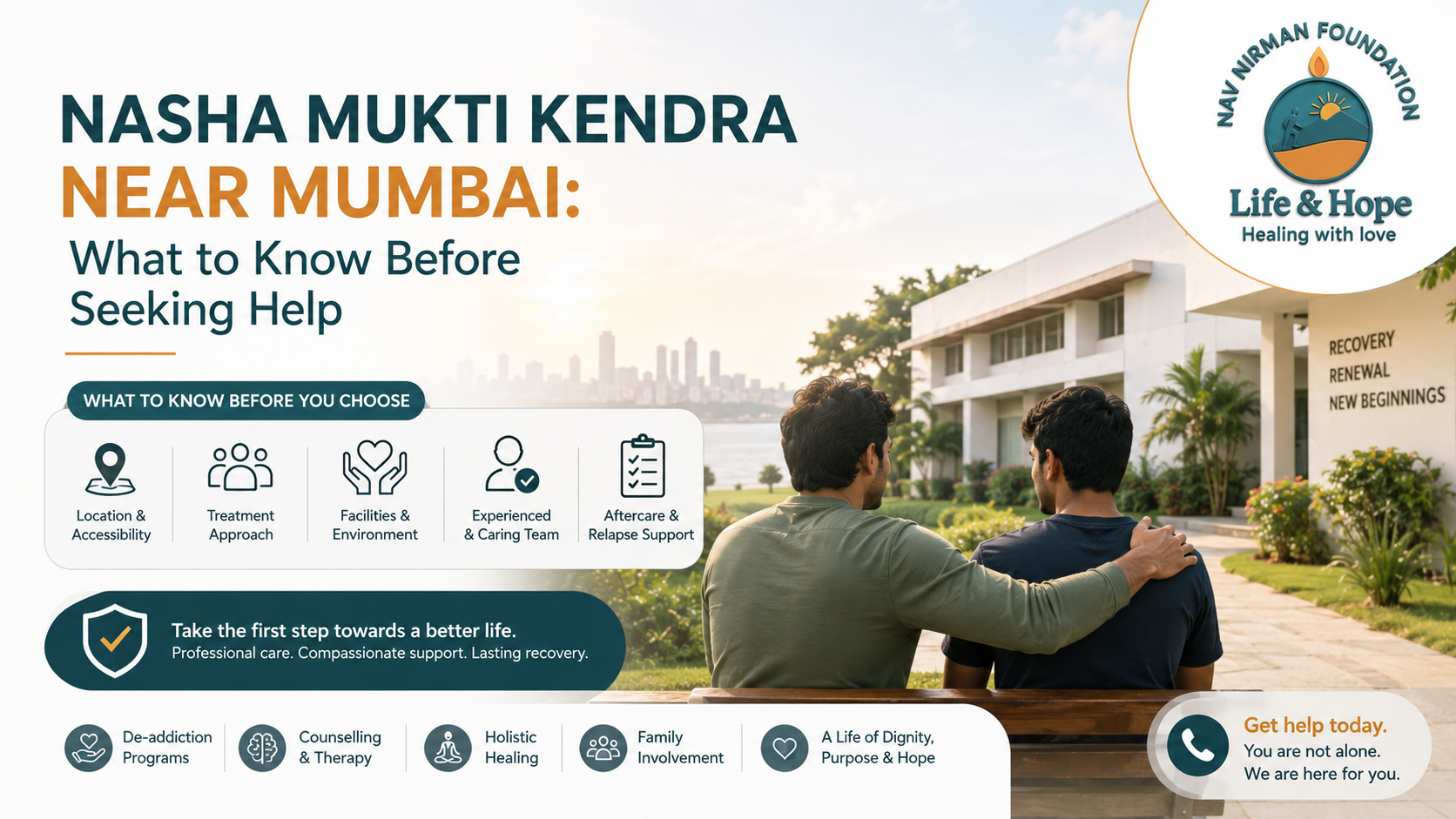
For millions of families across Mumbai, Thane, Navi Mumbai, and the wider metropolitan area, the phrase Nasha Mukti Kendra in Mumbai carries both hope and uncertainty. Hope, because it represents the possibility of recovery. Uncertainty, because the quality, cost, and clinical approach of different kendras vary enormously – and families often do not know what questions to ask or what standards to expect.
This guide covers what a properly run nasha mukti kendra near Mumbai should provide, what the admission process involves, what fees are realistic, and how to tell the difference between a centre that produces real recovery outcomes and one that simply provides temporary containment.
What a Nasha Mukti Kendra Near Mumbai Should Provide
The term nasha mukti kendra covers a wide range of facilities — from small, informal community centres to professionally staffed residential rehabilitation programmes. At the quality end of the spectrum, a properly run kendra near Mumbai should provide the following as standard:
- 24/7 nursing supervision throughout the residential stay
- Individual counselling in Hindi, Marathi, or the resident’s preferred language
- A qualified psychiatrist reviewing cases from admission onward
- Group therapy conducted in a culturally appropriate, community-focused format
- Family counselling integrated throughout the programme — not added as a single session at the end
- A medically supervised detox process for alcohol and drug withdrawal
- A written aftercare plan before discharge
If a kendra cannot confirm all of the above clearly, the programme may not be delivering the depth of care that lasting recovery requires.
Choosing a rehabilitation programme involves more than comparing facilities or fees. Families should also evaluate clinical staffing, detox supervision, psychiatric support, family involvement, aftercare planning, and the centre’s approach to long-term recovery. Those looking for a more detailed framework for assessing treatment quality can explore How to Choose the Best Rehabilitation Centre in Mumbai.
The Difference Between Sarkari and Private Nasha Mukti Kendras
Families in Mumbai frequently ask about sarkari nasha mukti kendra options and how they compare to private or NGO-run programmes. The honest comparison is as follows:
Sarkari (government) kendras: Free or heavily subsidised. Regulated by the state. Waiting times are typically significant — weeks or months in some cases. Individual clinical attention is limited due to staff-to-resident ratios. Appropriate when cost is the primary barrier and the individual’s situation is stable enough to wait.
Private kendras: Range enormously in quality. Some are excellent. Others use high fees to imply quality that the clinical programme does not support. The questions in the “What to Ask” section below help families distinguish between them.
NGO-run residential programmes: Often represent a practical middle ground between government facilities and premium private centres. When properly registered and clinically staffed, these programmes can provide medically supervised treatment, structured counselling, psychiatric support, and family involvement at a more accessible cost. For families comparing standards of care across facilities, this guide on choosing the best rehab centre near Mumbai explains the key indicators of programme quality and clinical credibility.
Nasha Mukti Kendra Fees in Mumbai: What Is Realistic
Nasha mukti kendra fees in Mumbai vary significantly based on the type of facility, the duration of the programme, and the clinical services included. A realistic breakdown:
Government facilities: Free or nominal charge. Waiting times and individual attention are the trade-offs.
NGO-run residential programmes: Typically provide one of the strongest balances between affordability and clinical support. Families looking for cost-effective residential treatment options can also explore this guide to affordable rehab near Mumbai.
Private residential centres: Costs vary significantly depending on accommodation standards, staffing levels, and programme structure. Some premium facilities position themselves as luxury rehab centres near Mumbai, offering enhanced amenities and lower resident-to-staff ratios. However, higher fees alone should not be viewed as evidence of better clinical outcomes.
For a full breakdown of treatment costs and timelines across different dependency types near Mumbai, this resource is directly relevant: Rehab Centre in Mumbai: Alcohol, Drug Addiction Cost and Timeline.
Admission Process at a Nasha Mukti Kendra Near Mumbai
Families often delay seeking help because the admission process feels unknown and therefore intimidating. A properly run nasha mukti kendra near Mumbai should make this process clear, pressure-free, and accessible.
The standard admission process at a quality centre involves:
Step 1 — Initial consultation: A free, confidential conversation with a senior counsellor — by phone, WhatsApp, or in person. In Hindi, Marathi, or English, based on the family’s preference. No commitment required at this stage.
Step 2 — Clinical assessment: A detailed review of the individual’s substance history, physical health, mental health, and family situation. This shapes the treatment plan.
Step 3 — Detox phase: Where medically required, a supervised Detox program in Mumbai begins the residential stay. For alcohol dependency specifically, this phase requires medical monitoring due to the potential complications that can arise during withdrawal. Effective treatment extends beyond detox and includes structured therapy, relapse prevention planning, and ongoing recovery support, all of which are discussed in greater detail in the Alcohol Addiction Treatment in Mumbai guide.
Step 4 — Residential therapy: Individual and group counselling, psychiatric management where required, holistic wellness sessions, and family involvement throughout.
Step 5 — Discharge planning: A written aftercare roadmap agreed before the resident leaves, including follow-up sessions, crisis contact details, relapse prevention guidance, and support for family members.
Recovery does not end at discharge. Long-term success depends on how each stage of treatment connects to the next, from admission and detox through therapy, discharge planning, and aftercare. Families who want a detailed overview of this process can explore the Mumbai Rehab Centre: Detox to Aftercare Guide.
Alcohol Nasha Mukti Kendra Mumbai: What the Treatment Involves
Alcohol dependency is the most common presentation at nasha mukti kendras near Mumbai. The clinical approach involves three distinct phases: medically managed withdrawal, therapeutic recovery work, and structured aftercare.
The withdrawal phase for alcohol dependency carries genuine medical risk if unmanaged, including seizure risk for long-term heavy drinkers. This is why a kendra with 24/7 nursing and on-site medical oversight is essential for alcohol cases, not optional.
The therapeutic phase involves individual trigger-mapping work, group sessions focused on relapse prevention, and family counselling that addresses the enabling patterns that frequently develop around alcohol dependency in Indian family systems.
Many individuals entering treatment for alcohol dependency also experience co-occurring mental health conditions such as depression, anxiety, chronic stress, or trauma-related symptoms. In these situations, recovery outcomes are often stronger when both conditions are addressed together through an integrated dual diagnosis treatment approach rather than treating addiction in isolation.
Drug Nasha Mukti Kendra Mumbai: What the Treatment Involves
Drug dependency cases at nasha mukti kendras near Mumbai cover a wide range of presentations, including prescription drug misuse, opioids, cannabis, stimulants, and polysubstance dependency. The clinical approach varies significantly depending on the substance involved, the duration of use, and the individual’s physical and psychological health.
A properly run drug nasha mukti kendra Mumbai programme should have experience across this full range and should not apply a generic treatment protocol to every case. Families should ask specifically about the centre’s experience with the relevant substance category, detox requirements, and long-term recovery planning before committing to admission.
Effective treatment typically combines medical supervision where required, individual counselling, group therapy, relapse prevention planning, and ongoing aftercare support. Those seeking a deeper understanding of treatment approaches for different forms of substance dependency can explore the guide on Drug Addiction Treatment in Mumbai.
For women experiencing drug dependency, treatment may also need to address gender-specific concerns such as trauma, family responsibilities, social stigma, and personal safety. The Women Rehabilitation Centre in Mumbai provides additional information on specialised treatment programmes designed for women.
Mental Health and Dual Diagnosis at a Nasha Mukti Kendra Near Mumbai
A significant proportion of individuals arriving at nasha mukti kendras near Mumbai have a co-occurring mental health condition alongside their addiction. Depression, anxiety, PTSD, and stress-related disorders are among the most common presentations.
A kendra that treats only the addiction, without addressing the underlying or co-occurring mental health condition, is managing symptoms rather than treating the full clinical picture. This is one of the most common reasons for relapse following an otherwise apparently successful residential stay.
Effective recovery often requires an integrated approach that addresses both substance dependency and mental health concerns simultaneously. When conditions such as depression, anxiety, trauma-related symptoms, or chronic stress are left untreated, they can continue to drive addictive behaviours even after detoxification and residential treatment have been completed.
Families seeking to understand how counselling, psychological assessment, and ongoing mental health support fit into the recovery process can learn more through mental health counselling in Mumbai, including the role of integrated care in long-term recovery outcomes.
Final Thoughts
A nasha mukti kendra near Mumbai that genuinely works is one that treats the whole person, not just the substance use. That means psychiatric care where required, family involvement throughout, culturally appropriate counselling in the resident’s own language, and an honest, transparent aftercare process.
The right Kendra exists near Mumbai, and the first step, a free, confidential consultation, costs nothing and commits you to nothing.
Call: +91 9833775447
Whats App: +91 9833775447
Email: help@navnirmanfoundation.com