Addiction Does Not Happen to One Person Alone
Every family that has lived with addiction knows the weight of it. The person drinking or using substances carries their dependency visibly. But the people around them carry something just as heavy — the anxiety, the uncertainty, the exhausted cycles of hope and disappointment, the arguments at midnight, the secrets kept from neighbours and colleagues. Addiction changes everyone it touches, not just the person at the centre of it.
This is the reality that family counseling for addiction Mumbai is designed to address. Professional addiction treatment has moved decisively away from the model of treating only the individual and returning them to an unchanged home environment. Clinical research now clearly shows that the family system either supports recovery or actively undermines it — and that which one it does has less to do with intention than with patterns, communication habits, and unresolved emotional dynamics that nobody chose but everyone inherited.
If your family is going through this right now, this blog is for you. Not just for the person who is struggling, but for you — the spouse, the parent, the sibling, the child — who is trying to hold everything together while also dealing with your own pain.
What Addiction Does to the Family System
The addiction impact on family Mumbai households experience is both immediate and cumulative. In the early stages, it looks like stress — more arguments than usual, some financial strain, a sense that something is off but nothing serious enough to name. As dependency deepens, the patterns become more entrenched.
Spouses develop hypervigilance, constantly monitoring for signs of drinking or drug use. Children learn to read the emotional temperature of a room before they enter it. Parents cycle between enabling and confrontation without knowing how to break out of either. Siblings pull away to protect themselves. Everyone adapts — and most of those adaptations, while understandable, make things worse over time.
Codependency is one of the most clinically significant patterns that emerges. Codependency counseling Mumbai sessions help family members recognise the specific ways they have unconsciously organised their behaviour around the addicted person’s dependency — covering for them, making excuses, absorbing consequences that should belong to the person using. None of this is done with bad intent. All of it is done out of love and fear. And yet it consistently delays the addicted person from reaching the point where they genuinely seek help.
Understanding this is not about blame. It is about giving families the tools to change patterns that are keeping everyone stuck.
Who Family Therapy Actually Helps
Family therapy is not a single-size intervention. Different family members need different kinds of support, and skilled therapists adjust their approach accordingly.
For spouses and partners, sessions through family counseling for addiction Mumbai focus on rebuilding trust after betrayal, processing resentment and grief, and developing communication skills that do not devolve into conflict. Many partners have been managing the situation alone for so long that having a facilitated space to speak honestly feels unfamiliar and initially uncomfortable — but it is also where the most significant shifts happen.
For parents, the pain is particular. Watching a child — at any age — struggle with addiction is one of the most distressing experiences a parent can face. Parents of addicts support group Mumbai access and structured individual sessions help parents separate responsibility from guilt, and learn the difference between supporting recovery and enabling continued use.
For children growing up in a household shaped by a parent’s substance dependency, therapeutic support helps them name what they are experiencing, understand that it is not their fault, and develop coping skills that will serve them throughout life. Children of alcoholics carry specific emotional burdens that, when left unaddressed, have documented long-term effects on mental health and relationship patterns. Mental Health Counseling Mumbai services complement this work for younger family members who need additional psychological support.
What Happens in a Family Therapy Session
Many families hesitate because they do not know what to expect. The uncertainty feels risky — what if things get worse in the session, not better? What if someone says something that cannot be unsaid?
Skilled family therapists are trained specifically to prevent sessions from becoming unstructured arguments. Every session has a structure and a purpose. Early sessions typically focus on creating safety — establishing that each person can speak without being interrupted or attacked, and that the therapist is there to facilitate, not to judge or take sides.
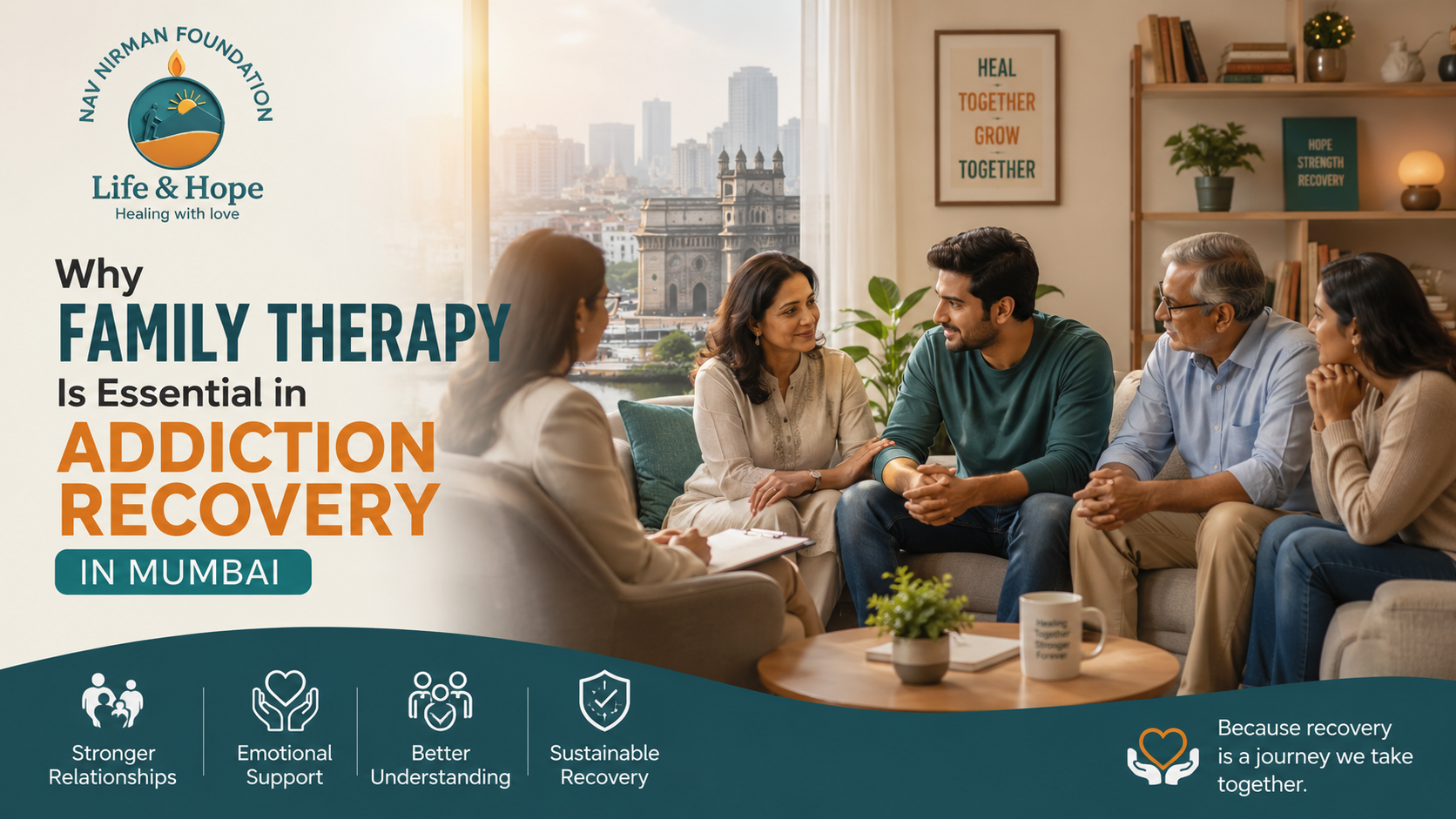
From that foundation, sessions move into more substantive territory: mapping the family’s communication patterns, identifying how each person has been affected, and beginning the collaborative work of changing what is not working. Family therapy for addiction Mumbai sessions at our centre are not confrontational by design. They are structured, purposeful, and guided by clinical experience in how families heal from the specific wounds that addiction creates.
For patients already in residential care, family sessions run in parallel — meaning both the individual and their family are progressing at the same time, in complementary directions. Families engaging with the Addiction Treatment Alcohol or Drug Addiction Treatment in Mumbai programmes at our centre receive structured family therapy built into the treatment timeline, not bolted on as an afterthought.
The Specific Work of Family Therapy in Recovery
Beyond the general goals of improved communication and reduced conflict, family therapy in addiction contexts addresses a specific set of clinical tasks.
Setting and maintaining boundaries is one of the most significant. Many families have been unable to hold boundaries because fear of what the addicted person might do keeps them from following through. Therapy provides the structure and professional support to develop boundaries that are healthy, consistent, and actually maintained.
Addressing trauma is another. Families living with long-term addiction often carry significant unresolved trauma — frightening incidents, broken promises, financial crisis, domestic instability. These experiences do not resolve themselves when the person in recovery begins to stabilise. They need direct therapeutic attention.
Preparing for the return home after residential treatment is perhaps the most practically important piece of family therapy work. The transition from residential care back into the family environment is a high-risk period. Families that have used the residential period to do their own therapeutic work are significantly better equipped to support the person in recovery without slipping back into old patterns that triggered use in the first place.
For families whose loved one is also dealing with co-occurring psychiatric conditions, the Dual Diagnosis Treatment Mumbai programme provides integrated support that family sessions are aligned with — so everyone is working from the same clinical understanding of what is happening.
Starting Family Therapy Before the Addicted Person Is Ready
One of the most important things families need to hear is this: you do not have to wait. Family therapy does not require the person with the addiction to be in treatment or even to agree that there is a problem. Family members can begin their own therapeutic process independently.
Counseling for families of addicts Mumbai is available for anyone who is dealing with a loved one’s substance use, regardless of where that person is in their own readiness to change. Often, when family members begin to shift their communication patterns and stop enabling behaviours, the addicted person’s situation changes too — not because they are pushed or forced, but because the familiar dynamics that kept things stable (and stagnant) have shifted.
Family intervention for addiction Mumbai processes can also be professionally facilitated when a family is at a crisis point and needs structured support to encourage a loved one to enter treatment. Our intake team can walk families through what a professional intervention looks like and whether it is appropriate for their specific situation.
Family Healing After Addiction Is a Long-Term Process
Recovery is not an event. It is a process that unfolds over months and years. Family healing after addiction Mumbai takes time — and that is not a failure. It is simply the reality of how deeply addiction reshapes family dynamics and how much sustained effort it takes to rebuild what was damaged.
Our complete guide to the Mumbai rehab recovery process includes a section specifically on what families should expect in the months following discharge — the realistic timelines for rebuilding trust, the warning signs of early relapse, and how to access support if things become difficult again.
The rehab centre mumbai aftercare network also connects families with ongoing counselling, alumni support groups, and community resources so that the therapeutic work begun during the residential period does not simply stop when the patient returns home.
Frequently Asked Questions About Family Counseling for Addiction in Mumbai
Q1: Does family counseling work even if the addicted person refuses treatment?
Yes. Family members can begin counseling independently, without waiting for the person with the addiction to agree. In fact, when family members start shifting their own patterns — particularly around enabling and communication — it often creates meaningful change in the family system that influences the addicted person’s readiness to seek help. You do not need their permission to start your own healing.
Q2: What is codependency and how does it affect recovery?
Codependency is a pattern where a family member’s emotional wellbeing becomes overly tied to managing the addicted person’s behaviour. It often involves covering for the person, absorbing their consequences, or organising daily life around their substance use. While these behaviours come from a place of care, they can unintentionally delay the person from reaching a point of genuine accountability. Family counseling helps identify and change these patterns in a safe, guided way.
Q3: How long does family therapy for addiction take in Mumbai?
There is no single fixed timeline. During a loved one’s residential treatment, family sessions typically run weekly or fortnightly alongside the patient’s own therapy. After discharge, many families continue with monthly sessions for 6 to 12 months as part of structured aftercare. The depth and duration of involvement depends on the complexity of the family dynamics and what each member needs to process.
Q4: What happens in a family therapy session at a rehab centre?
Sessions are structured and facilitated by a trained therapist. Early sessions focus on creating a safe space for each person to speak honestly. Over time, sessions move into mapping communication patterns, addressing unresolved emotional wounds, setting healthy boundaries, and preparing for the patient’s return home. Sessions are not confrontational by design. The therapist guides the process to keep it purposeful and productive.
Q5: Can children attend family therapy sessions at a Mumbai rehab?
Yes, where clinically appropriate and with parental consent, children can be included in age-appropriate family sessions. Younger children and adolescents often benefit from having their experiences acknowledged in a safe, professional setting. Where more intensive individual support is needed for a child, separate therapeutic sessions can be arranged alongside the family programme.
You Do Not Have to Navigate This Alone
Families dealing with a loved one’s addiction carry enormous weight. Professional support exists specifically to take some of that weight off your shoulders — not to replace the family’s role in recovery, but to equip you to play that role in a way that actually helps.
Start your recovery journey by speaking with our team. We offer confidential guidance for families at every stage — whether your loved one is just starting treatment or has been struggling for years. The conversation costs nothing. The insights can change everything.
Call: +91 9833775447
Whats App: +91 9833775447
Email: help@navnirmanfoundation.com