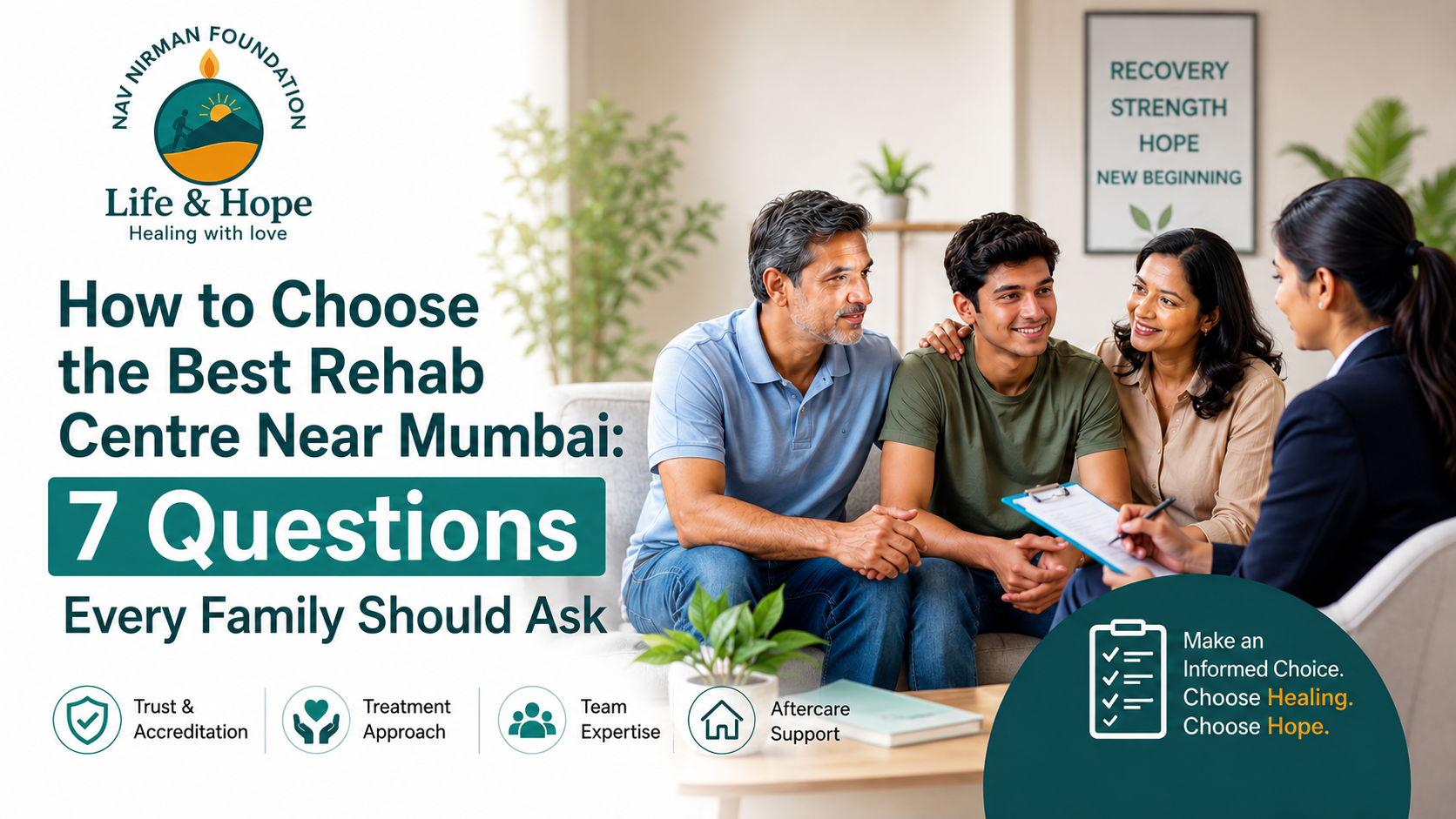
Searching for the best rehab centre near Mumbai when someone you care about is in active addiction is one of the most stressful situations a family can face. There are dozens of options across the Mumbai metropolitan area — private facilities, government centres, NGO-run programmes, and everything in between. Some are excellent. Some are not. And the marketing materials rarely help you tell the difference.
This guide gives you seven direct, clinical questions to ask any rehabilitation centre before committing to admission. The answers — or the quality of the answers — will tell you more than any brochure.
Question 1: Is There a Psychiatrist On-Site Throughout the Residential Stay?
This is the single most important clinical question to ask. Addiction rarely exists in isolation. A significant proportion of individuals entering residential treatment have a co-occurring mental health condition — depression, anxiety, PTSD, or bipolar disorder — that needs to be identified and managed alongside the addiction.
A centre that offers psychiatric assessment only at admission or that has a psychiatrist “available on call” rather than present on-site is not equipped to manage complex dual diagnosis cases properly. For a deeper understanding of how co-occurring mental health conditions are assessed and treated alongside addiction, the Dual Diagnosis Treatment Mumbai programme provides additional clinical insight.
Question 2: Are Treatment Plans Built Individually or Assigned by Default?
The best rehab centre near Mumbai will build a treatment plan around the specific individual — their substance history, their triggers, their co-occurring conditions, their family situation, and their personal recovery goals. A centre that assigns every resident the same 30-day schedule regardless of their clinical picture is not delivering personalised care.
The answers will quickly reveal whether individual planning is genuine or performative.
Question 3: How Is the Detox Process Managed?
For alcohol and certain drug dependencies, the withdrawal phase carries genuine medical risk. Seizures, severe dehydration, and cardiovascular complications can occur during unmanaged alcohol withdrawal. A medically supervised Detox program in Mumbai with continuous vital monitoring and a qualified medical team on-site is not optional — it is a clinical necessity for anyone with a significant physical dependency.
Ask specifically: Who monitors the resident during detox? How often are vitals checked? And what is the protocol if a medical complication arises?
Question 4: What Does Family Involvement Look Like?
Recovery does not happen in isolation from the family system. A residential programme that keeps families at arm’s length until the final week of treatment is missing a critical component of the recovery process. Families need to understand how addiction developed, how enabling patterns form and perpetuate dependency, and how to support recovery after discharge without inadvertently undermining it.
The best rehabilitation centres near Mumbai integrate family counselling throughout the residential stay — not as a courtesy at the end, but as a structured clinical component from the first week.
Question 5: What Specific Programmes Are Available for Alcohol vs Drug Dependency?
Alcohol addiction and drug addiction are distinct clinical presentations that require different treatment approaches. A programme that treats both identically is applying a generic model to a clinical situation that requires specificity.
For alcohol dependency specifically, ask about the detox protocol, the timeline, the medication management approach, and the trigger-identification work that happens during residential treatment. Readers who want a deeper understanding of alcohol-specific recovery strategies can explore the Addiction Treatment Alcohol program for additional clinical detail.
For drug dependency, ask about the specific substances involved, whether the centre has experience managing polysubstance cases, and what the post-detox stabilisation process looks like. The Drug Addiction Treatment in Mumbai programme provides further insight into treatment planning, recovery stages, and long-term support for substance dependency.
Question 6: What Does Aftercare Look Like?
A residential programme that ends at discharge is not a complete treatment programme. Relapse risk is highest in the weeks and months immediately following discharge — when the individual re-enters their home environment, their social circles, and the triggers that contributed to the dependency in the first place.
The best rehab centre near Mumbai will provide a written aftercare plan before discharge — not a verbal mention on the last day. That plan should include confirmed follow-up sessions, a named contact for crisis support, and clear guidance for the family on what to do if warning signs of relapse appear.
For readers who want a clearer understanding of the complete recovery process, from initial admission and medical detox through residential treatment and ongoing aftercare, the Mumbai Rehab Centre: Detox to Aftercare Guide provides a detailed step-by-step overview of the rehabilitation journey.
Question 7: Is the Facility Registered and Clinically Governed?
Registration with the relevant state authority and compliance with clinical governance standards is the baseline requirement for any legitimate residential rehabilitation facility. Ask directly whether the centre is registered, under which authority, and when the last external review was conducted.
A well-run centre will answer these questions immediately and transparently. Evasiveness regarding registration, licensing, or governance standards should be treated as a significant warning sign.
For families comparing different treatment providers, the guide on How to Choose the Best Rehabilitation Centre in Mumbai offers additional insights into the factors that distinguish high-quality rehabilitation programmes from facilities that focus primarily on marketing rather than clinical care.
The Difference Between Best and Most Expensive
One of the most persistent misconceptions in the Mumbai rehabilitation sector is that the most expensive programme is automatically the best. This is not reliably true. What determines outcomes is clinical depth — the quality of the psychiatrist, the consistency of the counselling, and the honesty of the aftercare planning. A centre with a lower price point but strong clinical governance can often outperform a high-cost facility with impressive aesthetics but limited clinical infrastructure.
For families working within a specific budget, exploring affordable rehabilitation options near Mumbai can help identify programmes that balance clinical quality with financial accessibility. The Affordable Rehab Near Mumbai guide explains how to evaluate treatment options and access effective care without compromising on essential clinical standards.
Location: Government, Private, and NGO Options Near Mumbai
Mumbai and its surrounding districts have three broad categories of residential rehabilitation:
Government centres: Registration is typically free or heavily subsidised. Waiting times are significant, individual attention is limited, and residential capacity is constrained. Appropriate for situations where cost is the primary barrier and timing is flexible.
Private facilities: Range enormously in quality and cost. Some are excellent. Others use high pricing to obscure weak clinical programmes. The seven questions above are your primary tool for distinguishing between them.
NGO-run residential programmes: Often the strongest combination of clinical quality and accessible pricing. Registered, professionally staffed, and structured around patient outcomes rather than commercial margins. For families in the Mumbai region, NGO-run options in the Kalyan-Murbad corridor offer genuine clinical quality at rates significantly below private sector pricing.
Final Thoughts
Choosing the right residential rehabilitation programme near Mumbai is not a decision that should be made on the basis of a website or a phone call alone. Visit the facility, meet the clinical lead, and ask the seven questions outlined above. The quality and clarity of the answers will often tell you more than any brochure or marketing material.
The right programme exists near Mumbai — properly staffed, clinically sound, and accessible to families across the metropolitan area. For those comparing different treatment pathways, durations, and budget considerations, understanding rehabilitation costs and recovery timelines in Mumbai can help make the decision more informed. The Rehab Centre in Mumbai: Alcohol, Drug Addiction Cost and Timeline guide provides a detailed breakdown of treatment options, expected programme durations, and key cost factors to consider before admission.